What Nepal’s Gen Z Really Wants: Democracy, Elections, and a Nation in Question
By: Sandip Risal
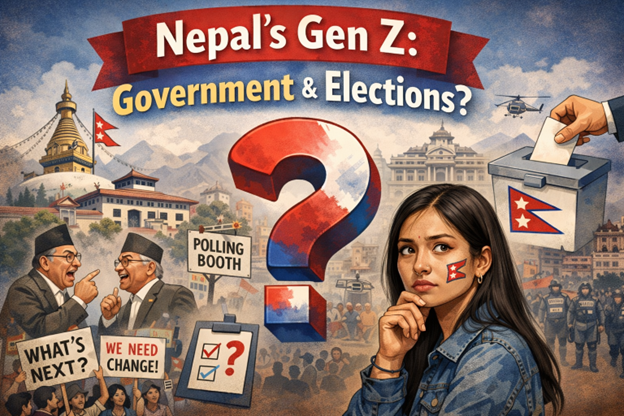
Nepal, widely known as politically unsettled country for decades has reached to next level of chaos. The recent shift of power to non-political sects has heightened this uncertainty, giving less priority to established political parties and creating undesired pressure from different levels. It is challenging for this interim government to ensure a peaceful handover of power to political parties through fair and timely elections.
Pressure from Political Parties
The aftermath of Gen-Z protest suggested that the established political parties would come up with reforms and accept the sentiments of the protest, which had the primary goal to eradicating corruption. However, within couple of weeks, the major political parties along with new ones, became polarized and divided. The recent number of new political party registrations in Election Commission does not indicate a stable political future. Most importantly, the divided Gen-Z, which has no structured group or leadership, has fragmented into more than dozen registered political parties. This has increased dependency on major political parties to create safe environment for elections. There can be a separate debate about the number of parties based on the population we have, under the democratic norms and values.
If we observe the statements given by Interim Prime Minister Sushila Karki and Home Minister, Om Prakash Aryal, before and after taking charge of the government, there is a paradigm shift. They tend to seek strong support from political parties like UML, despite some hiccups at the beginning. The frequent visits of second-rank leaders indicate the same. Moreover, the validity of this interim government is under review at the Supreme Court. There is still doubt that the verdict might favor political parties, bringing another uncertainty.
Pressure from Gen-Z
Since the government was formed under the foundations of Gen- Z’s protest, the interim government is unable to manage the pressure from different sects of these groups as there are delegations for different demands every day at the Prime- Minister’s and Minister’s office. It is a regular incident of protest and arrest in front of PMs office every day. It seems the major demands of these groups are to investigate former PM KP Oli and those who were in the government at the time. The strong reaction of political parties, especially UML, against Gen-Z, has created a tussle which will ultimately affect the upcoming elections. The government has shown disinterest in meeting such delegations, as they present different demands each day.
Influence of Geo-Politics
Nepal is always under the influence of geopolitical pressure. It is believed that even the elected governments could not deny pressure from different levels. During this stage of political liquidity, there is no doubt that the interim government is no exception. India’s pre- approval for the candidate for prime minister Sushila Karki and the Dalai Lama’s reaction to this newly formed government are not a coincidence. In addition, the connection between cabinet members like Jagdish Kharel and the Barbara Foundation is also on the radar. If we believe in Harka Sampang’s (the mayor of Dharan, who was also considered to lead the government) statement that approval from Indian Embassy was required for ministerial positions, clearly indicates the interference from Delhi.
The functioning of the Constitution
The current constitution is in a complex situation, as the current government is not formed under it. It was an outcome of Gen-Z revolution, supposedly having a mandate to conduct the election. It is controversial that the current PM, Sushila Karki, who is a former Chief Justice of Nepal, is forbidden from holding the prime ministerial role. However, she is in power, ignoring the fact. Moreover, the federal and local governments are functioning as usual under the constitution creating confusion about the existence. As of now, the only solution to reinstate it is to conduct the election and form a democratic government.
Threats to Law and Order
The recent movement has questioned the entire security system of Nepal, including the Nepal Army. As the front-line security force, the Nepal Police’s is struggling to boost its morale and still receiving threats from different levels. The recent incident in Simara and the government’s reaction to transferring the Police in charge were not encouraging to the entire organization. Most importantly, the government’s early declaration of the utilization of Army personnel in Election is premature and shows distrust toward the Police and Armed Police Force. As per the police, hundreds of inmates who escaped during the protest are still at large. Likewise, the recent statement by Home Minister Om Prakash Aryal about the lost weapons that could have been swept away by the river is irresponsible and raises concerns about his competency in leading the upcoming election.
Tussle between Political Parties
The major political parties, such as Congress, are still indecisive about the General Assembly and are engaged in extensive discussions on party reform. Moreover, there is division among the leaders whether they support the reinstatement of Parliament or not. This dilemma has turned the party to the verge of division. Despite the fact that this party has agreed to head towards the election, its internal conflict has overshadowed the political environment. The other major party, UML, who was leading the government during the revolution, is under threat from different sectors. However, it responded across the country with various demonstrations. The President of this party K.P Oli, is under the investigation and has been confined to the Kathmandu valley, as he was in charge of the government during the revolution, which caused deaths. UML has rejected this approach and declared not to support Gauri Bahadur Karki-led investigation committee due to its pre-declared culprit in social media. KP Oli’s fresh mandate, with two third majority within his party, indicates that he and his party remain major stakeholders in Nepali politics. The third major political party, formerly the Maoist, had dispersed but has since reunited with other small communist party is now focusing on its unification campaign. The Rastriya Swatantra Party is also facing side-effects of polarization, as some of the established leaders like Sumana Shrestha and Sanosh Pariyar, have left dissatisfied with the leadership’s style and vision. Most importantly, there is no formal meeting among the major political parties to discuss the country’s roadmaps, which is very disappointing in the current scenario.
Moving Forward
Overall, in this critical condition, there is a need for unity among political parties and other stakeholders. The current government should prioritize creating a trustworthy environment for the election by boosting the morale of Police force along with other bureaucrats and citizens. Most importantly, historical parties like Congress and UML should reform their structures and follow the sentiments of new generation by adopting zero tolerance toward corruption and speed up the development.